
Menu
Close
.svg)

A Step-by-Step Process Integrating Primary Marketing Research, Behavioral Science and Artificial Intelligence
When preparing for a new product launch or refreshing the messaging of an existing brand, one of the most important tools you need to get right is the core visual aid (CVA). The CVA provides the framework to communicate the key claims and benefits for your brand. For a product to be successful commercially, it must have a CVA that the sales force will readily and enthusiastically embrace.
It goes without saying: One of the biggest mistakes you can make is not planning for sufficient time, resources, and multi-disciplinary collaboration in the development of the CVA.
The CVA represents the culmination of numerous previous steps in the brand development cascade that includes buying process, segmentation, positioning, message testing, and campaign ideation. This is not the time to skimp on attention, focus and time.
As you plan for CVA testing, the marketing team should prepare for a systematic, multi-phased approach that incorporates both time-tested techniques and innovative technologies. The marketing team should also proactively engage with members of sales leadership, the sales team and sales training -- all team members who will eventually be end-users of the CVA.
Most visual aid testing methods aim to optimize the resource itself: the headlines and proof points, the graphs, the clarity of each page, and the overall narrative flow. In contrast, the approach we will describe helps to shape an effective selling tool that reps can leverage to be commercially successful by cultivating routine product usage by the target audience.
When we at ThinkGen collaborate with marketing teams to build an effective CVA, we start by picturing today’s actual real-world selling environment. This is the context in which a sales representative will be using the CVA.
The real-world selling environment has significantly changed over time. In the past, many doctors were open to meet with drug reps and often had ample time with them. How that model has changed. We all know that even in the most complex therapeutic areas, today’s reps often get only a harried 2-3 minutes, and many doctors don’t even have that much time. Today’s health care provider (HCP) are busy, distracted, and often burned out. Today’s HCP also is always thinking about the cost of treatments that she or he is prescribing, as the insurance company is the “third person in the room.”
Moreover, HCPs have to see a substantially greater patient volume than in years past and have increased administrative responsibilities. More reps than ever are vying for the HCP’s scarce attention: if the HCP is on your target list, they’re on the target list for other reps as well. And, like everybody else, HCPs are likely preoccupied by a host of other thoughts: family, personal interests, broader social concerns, etc.
The pharmaceutical marketing team therefore needs to craft a CVA that is not only designed to disrupt and break though, but also, over a series of subsequent, short encounters with that HCP, establish a new behavior: a routine habit that incorporates your product.
Ideally, your brand’s CVA will be developed within the context of a broader orchestra of promotional resources (i.e., omnichannel), all geared towards cultivating the desired behavior on the part of the HCP. The CVA needs to be crafted both in content and form so that the end-users - your sales representatives - adopt it as the centerpiece of their selling toolkit.
The CVA also may be used by the sales force to educate other members of the medical office about a given product. Most companies now are recognizing that the “total office sell” is necessary. Nurses, physician assistants and other office team members also need to be persuaded by the CVA so that as the doctors make prescribing the drug part of the office’s medical routine, so do they. The CVA development process must take other medical personnel into consideration, and their needs should be considered in the development and testing process.
The process of developing a CVA is a result of learnings and milestones established through previous stages of customer understanding and commercial preparedness marketing research. These steps include buying process/patient journey, segmentation, brand positioning, message development, and campaign concept testing.
Based upon previously established insights and decisions, the process of developing the CVA involves a multi-phased program of primary marketing research initiatives designed initially to optimize flow, language, graphs and visuals, and subsequently to perfect the way the CVA is actually delivered in front of customers as part of a broader, omnichannel initiative.
Importantly, the team needs to consider not just the first few visits, but how the CVA supports a series of encounters that will move the HCP on a journey from awareness and interest to successful trial and then regular usage. New insights into behavioral science demonstrate that behavioral change requires different information provided at different junctures of the change journey. Teams need to incorporate this insight into the development of the sales aid, and into sales training.
One point to note: this process can be applied whether to testing a CVA that is geared towards HCPs, other members of the office staff, or to patient- or caregiver-oriented materials, such as an educational brochure.
Additionally, we at ThinkGen are strong advocates for in-person, in-facility, face-to-face (F2F) research wherever possible, since this elicits higher levels of engagement on the part of the study respondent, and more opportunity for immediate huddling and brainstorming in the back room “insights laboratory.” Over the past few years, more pharma companies have embraced remote, virtual research, which may be more cost-effective but, we would argue (and have observed), leads to less engaged respondents.
We recommend starting the process by testing a preliminary draft book comprised of “words on the pages,” that is, the messages and supportive evidence demonstrated in previous research to be credible and compelling triggers of behavior. Previous message development research also should ideally have recommended a logical narrative blueprint and flow, and this too should be reflected in the white pages book that is tested.
This research step helps to test/refine the language of key elements such as headlines, body copy, graphs, etc. At ThinkGen, we recommend using AI algorithms like Phebi to identify what we call “power words” and “power phrases” – words and phrases that carry deeper meaning to HCPs, and which trigger a verbal emotive response.
This initial White Pages testing stage typically entails 1:1 customer interviews where study respondents are asked to review the document, often accompanied by an audio-taped voiceover presentation. We utilize a proprietary research platform to capture active and passive immediate reactions to key elements such as headlines, words, draft graphs, and then analyze the results of the audio using both standard content analysis as well as AI; AI can help to pinpoint where respondent verbal reactions signal either a strong positive, neutral or negative sentiment to the information presented.
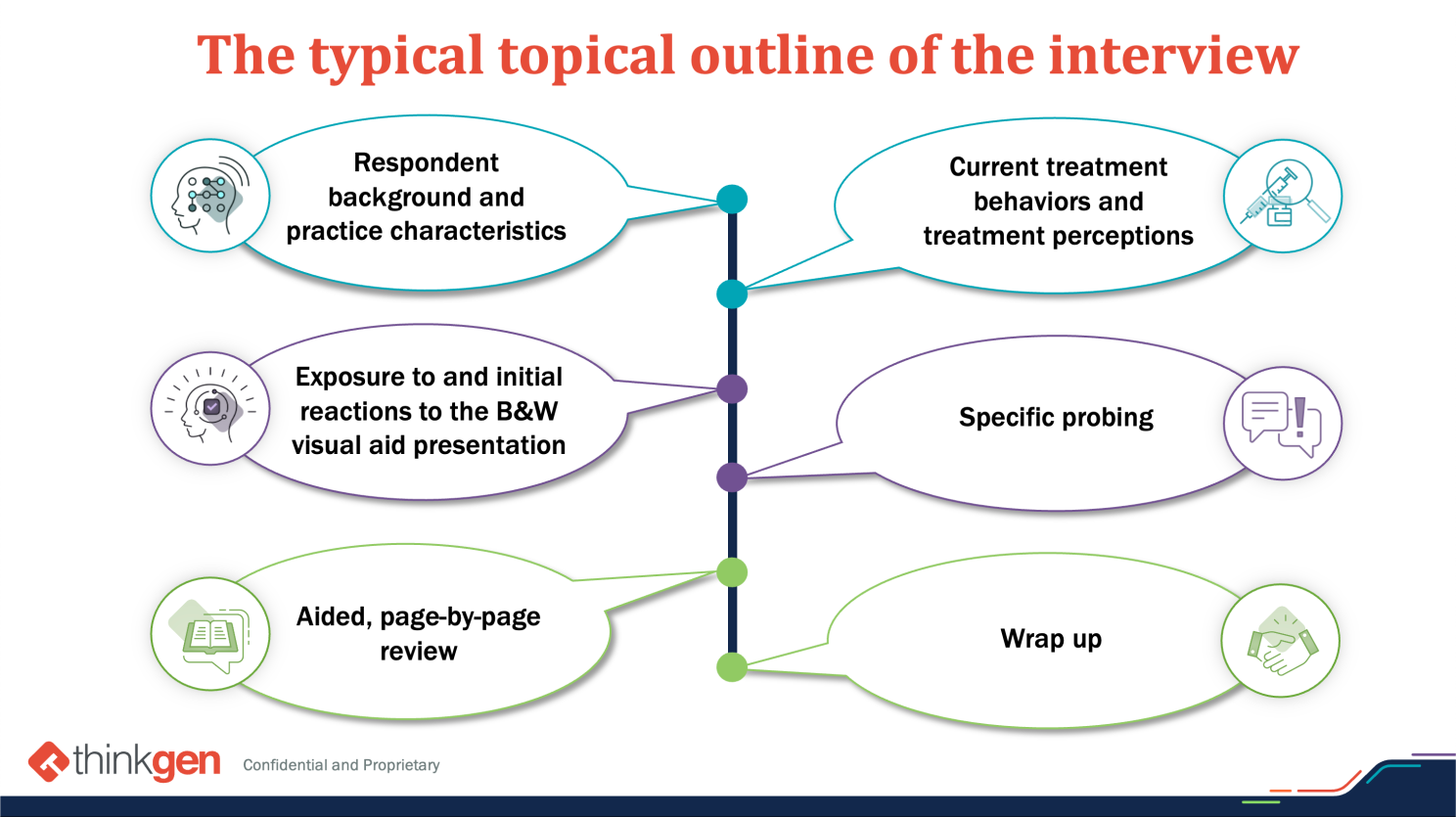
Interviews typically should last approximately 1 hour. During this initial stage of testing, there may be opportunities to test alternative elements of the CVA such as headlines, sub-heads, and graphs/charts.
The next step of testing involves the incorporation of branding elements and more finalized graphics into a more finished version of the visual aid. These branding elements and graphics ideally would have already been tested as part of the campaign idea research.
Here too, the market research data collection process should involve 1:1 interviews where the respondent is exposed to the full-color visual aid either via an audio-taped voiceover, or a live representative – a mock detail encounter.
The advantage of utilizing a live representative is that it is more realistic, is more of a two-way dialogue, and is more adapted to the specific reactions the respondent might have. Involving a member of the sales team at this stage also is a way for members of that team to start building their experience and confidence selling the product in front of actual customers. While there may be challenges of scheduling and pulling a sales representative out of the field for several days to participate in such research, the benefit is worth the hassle.
The interview flow should follow a similar topical agenda to the B&W visual aid testing. These interviews also are typically one hour long. During this interview, the team should strive to deeply focus on how the campaign and campaign elements blend with the content and flow of the visual aid. Specific elements that are important to assess are:
Here too, AI algorithms can be employed to identify specific words, graphs or other messaging that elicit strong emotive reactions on the part of the customer.
During this research step, the team should also strive to identify the most critical and compelling pages in the brochure to provide guidance to reps that face severe time-limited situations with HCPs.
The third stage of testing, which is rarely done but which serves an important role, is to put a close to final CVA into the hands of some sales representatives and to actually have them conduct live, in-person mock details in front of HCPs. There are several benefits of this real-world simulation. Important insights can be gleaned particularly around the execution of an effective detail encounter in a real-world that is time-constrained. Real-world research also can establish greater confidence to the sales force and provide customer input to sales training.
In conducting this research, it is important to try to impose some real-world parameters and constrictions to elevate the degree of realism. One is to limit the amount of time the representative has to present to the doctor, which helps ensure that the representative learns to focus on key messages and concise language. We suggest that the first exposure to the mock detail by the rep is no more than three minutes, and that a moderator then questions the HCP around the following topics:
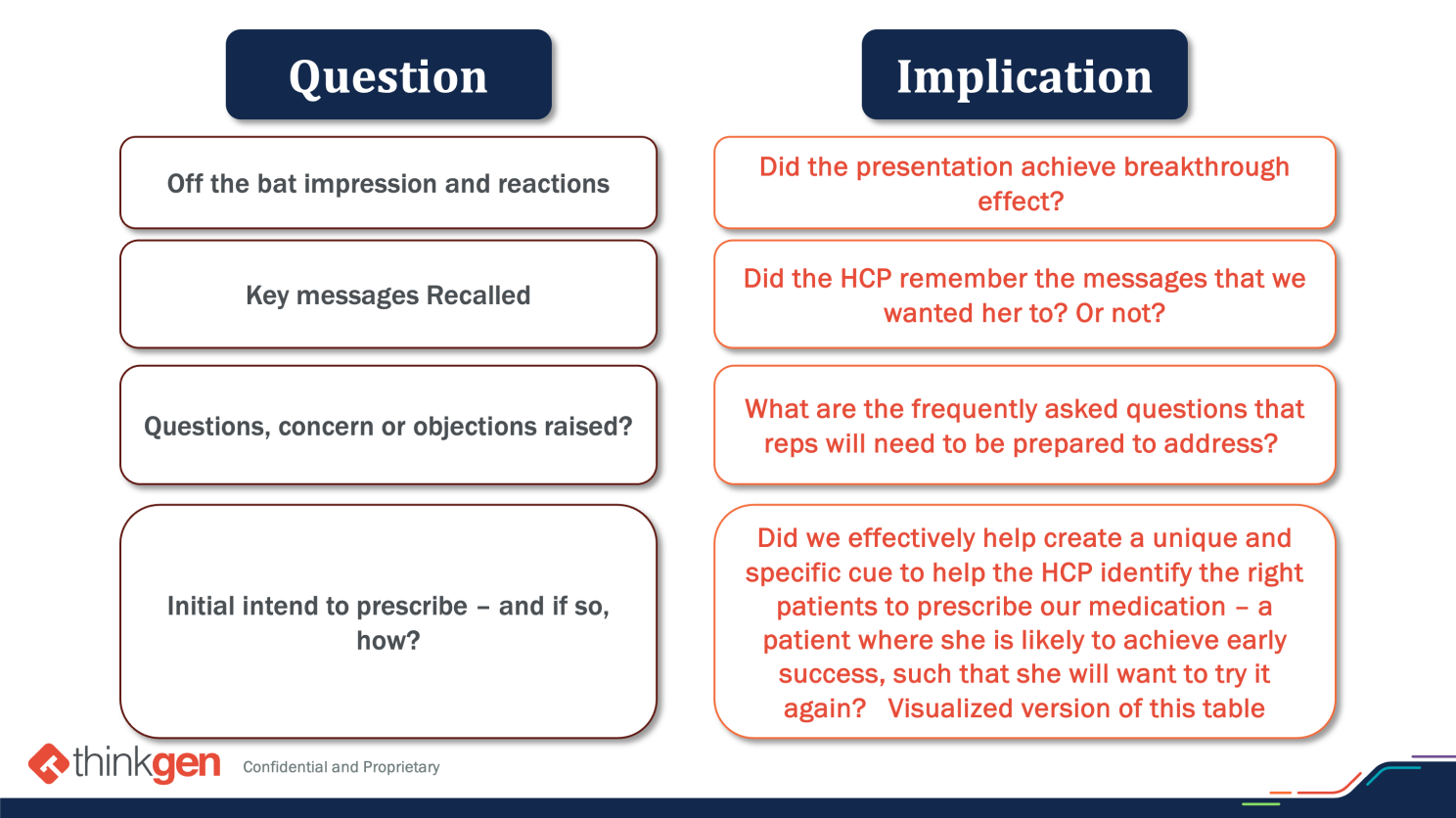
Looking carefully at the responses to these questions is critical because first impressions matter. The team needs to make sure that the presentation is engineered to catch the customer’s attention, to drive behavioral intent, and then to identify the right patient who can try the treatment.
We have written extensively about the importance of “hacking the cue,” i.e., identifying the right patient type, or patient circumstances, where the HCP should first use a medication; this is essential so that the HCP has a favorable first trial of the medication, and is reinforced to try it again. This is essential as the start of the HCP’s establishing a habit around using the product. Behavioral science tells us that we are more likely to repeat a behavior when we get reinforcing feedback.
The other critical element of this third stage of testing involves determining how to provide the information to customers in “stage gates.” The final CVA needs to be designed to be delivered to a busy, distracted HCP across a series of short-burst, often distracted meetings.
“Stage gates” are the key pieces of information to be presented on visit 1, visit 2, visit 3, etc. and should be prospectively established by the team based upon customer input and feedback. Information needs to be gated to help move the HCP along her journey from awareness and interest to trial and usage, and needs to be thoughtfully planned out according to their likely actions and results as they starts to use and gain experience with the product. For example:
Again, behavioral science teaches us that human beings are on an incessant hunt for feedback. For professionals treating health conditions, consistent favorable feedback is a potent motivator of repeat behavior. On the other hand, feedback interpreted as “punishing” can scuttle interest in repeat behavior. Reps therefore need to be prepared to provide more information when the early feedback from a product might be unfavorable (e.g., where a patient might need to overcome certain side effects early in the treatment), and/or where the onset of effect of a product might take time.
In our Habit Lens model, we term this concept “Behavioral Beliefs.” These are mental frameworks and models to help an HCP interpret feedback and help the patient interpret feedback. For example, the HCP might tell a patient that if they are experiencing flu-like symptoms initially, that should be seen as a positive signal that the drug is starting to work. Or the HCP might provide a real-world analogy to describe the way a medication is working in a patient’s body even though they can’t feel it happening, or the onset of action is slow.
In summary, this third phase of research is designed to address several practical and real-world considerations around the effective implementation of a CVA, and should focus on both the performative aspects, recognizing the real-world selling context, as well as the goal of establishing a routine habit on the part of the customer. By involving the sales team integrally, this research can start the ball rolling in establishing their confidence in giving reps an opportunity to get in front of customers, and to start to build the stage-gates of information deployment to support trial, early usage, and ultimately regular routine usage.
Every marketer has gone through the character-building experience of designing a sales aid that has not been used by the sales force.
Including members of the field sales team in the testing process helps ensure buy-in to the tool. Importantly, not only will these team members learn important insights during the testing process, they can then share these learnings with their colleagues with the credibility that only those who carry the bag can provide.
The field sales team benefits from hearing what HCPs think as they are presenting and learn how to adjust the narrative and work with the CVA in a simulated real-world environment – with the benefits of a “lab” environment where adjustments and different approaches are encouraged.
The in-facility research also provides an important team-building experience for our clients. As we all know, there is no substitute for the back room of a research facility for team discussion, alignment, and strategy development.
Importantly, when the CVA is ultimately rolled out to the field during a national meeting, inviting sales representatives to participate in the market research ultimately provides a high level of credibility to the rigor of the research process undertaken to support the CVA. Sales representatives who are able to speak from the podium about their experience impart authenticity and confidence in the best practices to be trained on as part of the rollout.
Our client’s compliance teams are brought on early in the process for several important reasons. To ensure that double-blinding of the market research study is maintained, sales team members cannot participate if they are located in the regions/geographies in which the research takes place. The sample sizes for these studies are typically small, with natural constraints in place due to the need to conduct these kinds of studies in person.
For clients who are not able to include a formal implementation phase as part of their CVA testing, many opt to ask their standing committees comprised of sales representatives/account managers to pilot the new CVAs during their sales calls. Because sales reps who test CVAs among their customers typically go to either their trusted “friendlies” or the more challenging physicians on their target list – which may not be representative of the typical physician – a formal implementation phase is certainly a preferred approach. However, the key is that some form of user testing with the end customer in mind – the sales representative – is critical.
Crafting an effective CVA is a challenge. Systematic testing is an integral part of the process, especially given the changes that are taking place in how doctors function in a more time-constrained and insurance-constrained environment.
While current modalities of CVA testing are effective at creating a clear and well-written encyclopedia of data, ThinkGen’s multi-phased testing process incorporates key stakeholders in the development of the CVA so that a range of important information can be more effectively delivered by the rep and understood by the customer for maximal behavioral impact.
