
Menu
Close
.svg)

In the years since, Habit Lens has been utilized extensively across therapeutic categories and lifecycle stages: from early launch planning to mid-lifecycle course correction, from crowded markets facing generic pressure to novel spaces encountering unexpected inertia. As its use has expanded, so too has the framework itself—most notably through its full integration with #ThinkAEI, ThinkGen’s proprietary AI platform.
What follows is not simply a retrospective. It is a reframing. Habit Lens 2.0 reflects what we have learned by applying this methodology across real commercial contexts; and how advances in AI now allow us to go deeper, faster, and with greater precision into the behavioral systems and structures that ultimately govern commercial success or failure.
Commercial teams often approach new product launches with a familiar analytical lens: unmet need, competitive differentiation, clinical advantage, and -- when relevant -- first-to-market status. On paper, these factors can signal extraordinary opportunity.
And yet, again and again, teams are surprised by resistance.
One of the most common, and most instructive, scenarios is this: a company launches the first FDA-approved product in a therapeutic space, only to discover that health care provider (HCP) behavior is already deeply entrenched. Clinicians may be using a non-approved therapy, an off-label approach, or a workaround that has quietly become highly habitual. That behavior may be automatic, routinized, and reinforced by years of experience...often combined with frictionless access.
From a traditional commercial standpoint, the market appears “open.” From a behavioral standpoint, it is anything but.
Habit Lens helps teams confront this reality early. It forces a more realistic assessment of what a team is truly up against -- not just in terms of competitors, but in terms of behavioral inertia and contextual constraints that can neutralize even the strongest clinical dataset.
One of the most counterintuitive insights for teams, particularly those launching new treatments with strong and/or superior clinical data, is that being better does not automatically mean being chosen.
HCPs operate within contexts defined by relentless time pressure, team-based workflows supported by digital systems, institutional norms, reimbursement realities, and the ever-present need to manage clinical and legal risk. Within these environments, strong and often remarkably tenacious habits form precisely because they reduce cognitive effort, increase efficiency, and mitigate uncertainty. Once established, these habits can persist even in the face of known disadvantages or superior alternatives. In many cases, habits have calcified over the course of a physician’s career -- originating in training, reinforced by early clinical experience, or inherited from a trusted mentor -- and are rarely revisited once they become the default.
This is where Habit Lens consistently resonates with marketers. Experienced marketers intuitively understand that habit often overrides intention. Customers may fully intend to change...and still default to the familiar. In the world of healthcare, where the stakes are high and efficiency matters more than ever, this dynamic is even more pronounced.
Habit Lens does not replace rational decision-making models; it explains what happens when decisions are repeated often enough that they become automatic. Together, these perspectives provide a more complete picture of how behavior actually unfolds in real-world clinical practice.
One of our explicit goals in developing Habit Lens was to create not just an analytic framework, but a systematic process and a shared lexicon.
Experienced marketers, particularly those who have been in sales, naturally sense the presence of habit, but lack the language to articulate it precisely or act on it strategically. Habit Lens provides that structure. It allows teams to unpack complex, automatic behaviors into component parts that can be examined, discussed, and ultimately influenced.
The framework organizes and sub-categorizes behavior across six interrelated dimensions:
Together, these elements explain why behaviors become automatic -- and why they can be so difficult to change.
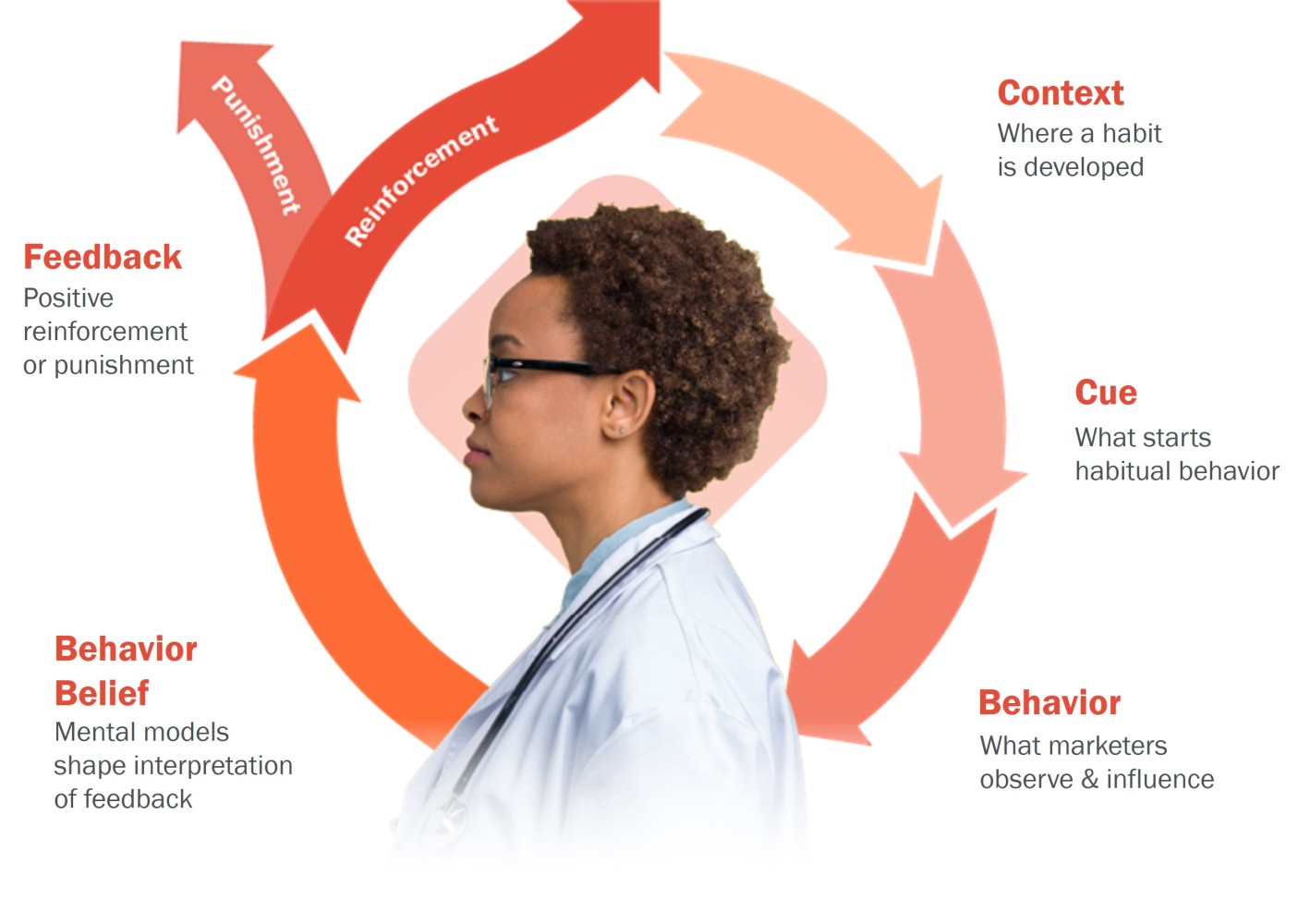
One of the most common questions we receive is when a Habit Lens study should be conducted. The answer is simple, though not always easy to act upon: as early as possible.
We strongly recommend that teams strive to develop a habit-informed perspective of their market during launch preparation and early market understanding. At this stage, assumptions are still forming. Strategic decisions about positioning, targeting, and investment are still flexible.
That said, Habit Lens is not limited to launch. It has proven equally valuable in other contexts including:
What these situations share is complexity. And complexity is precisely where Habit Lens excels.
Habit Lens is not a lightweight study. Teams who have conducted one know this well.
It requires more touchpoints, deeper discussion, and more rigorous synthesis than a typical marketing research engagement. It demands intellectual engagement from both researchers and commercial stakeholders. And it culminates not in a static deliverable, but in a working session.
This is intentional.
The typical output of a Habit Lens engagement is a Behavioral Change Plan: a pathway to behavioral change grounded in empirical insight and refined through the lived experience and commercial perspective of the team and its agency partners. This plan is usually developed in a facilitated workshop following the primary research.
The result is not just insight, but alignment: a shared understanding of what must change, what can change, and what should be preserved.
A recent, powerful illustration of Habit Lens in action comes from its application to genomic testing, an area often assumed to be driven purely by scientific literacy and technological progress.
In this case, Habit Lens revealed that adoption barriers were not rooted in lack of awareness or belief in value, but in deeply ingrained workflows and contextual cues that governed when, and whether, testing was even considered. Ordering behavior had become routinized around specific triggers, timing constraints, and perceived downstream consequences.
By mapping these dynamics across the Habit Lens framework, the team was able to identify where behavior had become automatic, where feedback reinforced the status quo, and where disruption was possible without elevating friction. The resulting Behavioral Change Plan focused not on persuasion alone, but on restructuring cues and context to make a new behavior easier, and more natural, to adopt.
The integration of #ThinkAEI represents the most significant evolution of Habit Lens since its introduction.
ThinkAEI enables us to interrogate qualitative data, particularly in-depth interview transcripts, with far greater rigor, consistency, and scale. It surfaces linguistic nuance, identifies recurring behavioral patterns, and systematically maps language back to the core Habit Lens constructs. Because Habit Lens interviews are intentionally respondent-led rather than moderator-led, meaning is often embedded in how things are said rather than what is explicitly stated. ThinkAEI allows us to sift through this richness with precision, ensuring that subtle but consequential insights are captured, categorized, and translated into a coherent behavioral architecture.
More importantly, ThinkAEI helps pinpoint where intervention is possible. It highlights moments where habits could be disrupted by making behavior more conscious, where feedback could be reframed, or where investment barriers could be lowered.
We believe that the future is human intelligence + artificial intelligence. ThinkAEI does not replace human interpretation; it sharpens it. ThinkAEI enables the research team to move from insight to action with greater confidence and speed.
Ultimately, products do not succeed or fail based solely on trial. They succeed, or fail, based on whether they become habitual.
A habit is an automatic behavior. eCommerce companies like Amazon design entire ecosystems around making purchase decisions effortless and repeatable. Social media platforms such as Meta or X are built on behavioral loops that reinforce habitual engagement. As Nir Eyal famously articulated in Hooked, habit is not an accident: it is architecture, it is systems design.
Healthcare is no different. The difference is that habits in healthcare are shaped by professional responsibility, clinical risk, and institutional context. That makes them harder to see; but no less powerful.
Habit Lens helps illuminate these structures. It reveals the systems underlying behavior, whether the goal is to engineer a new habit or disrupt an existing one.
As teams plan their marketing research agendas for 2026, we believe it is the right moment to bring Habit Lens back into focus. Not as merely "innovation," but as a strategic necessity.
The commercial landscape is more complex, more constrained, and more competitive than ever. In such an environment, understanding behavior at a surface level is no longer sufficient. Success depends on understanding how behavior actually works -- and how it changes.
Habit Lens 2.0 represents a maturation of that understanding. Grounded in behavioral science, informed by real-world application, and accelerated by ThinkAEI, it offers teams a clearer path through complexity.
Because in the end, strategy succeeds not when it persuades, but when it changes what people do, automatically, day after day.
